
How to Choose Eyeglasses: The 2026 Buying Guide
How to Choose Eyeglasses
11 min read • Posted on 26 August 2026
Choosing eyeglasses is one of those decisions that quietly compounds — the pair you buy today will sit on your face for eight to twelve hours a day, every day, until your next prescription update. That’s why how to choose eyeglasses is worth treating as a multi-part question rather than a style call: prescription accuracy, coating quality, frame construction, and long-day fit all pull in slightly different directions. A pair built for a screen-heavy job answers very different questions than a pair built for reading, running errands, or hiking on weekends, and the buyer who gets those questions right ends up with glasses they barely notice wearing.
What you’ll find below:
-
What to look for when buying eyeglasses
-
Understanding lens types, prescriptions, and coatings
-
Frame materials that matter for daily wear
-
How to size eyeglasses properly (and why PD matters)
-
Choosing by use case (office, everyday, active, reading, sensitive eyes)
-
How to verify prescription accuracy and coating quality
-
Warranty, returns, and how long good eyeglasses should last
Already know the frame shape you want? Skip ahead to the Face Shape Guide for Glasses for the shape-by-shape breakdown. Otherwise, the essentials start here.
What to look for when buying eyeglasses
A good pair of eyeglasses lives or dies on four things: an accurate prescription cut into the right lens material, coatings that come standard rather than as upsells, frame construction that holds its shape over time, and a fit that stays put across a full day. Colour, brand name, and price range all matter less than any of those four.
-
Prescription accuracy — lenses cut precisely to your prescription, PD, and pupil height, ideally at an in-house optical lab so quality control isn’t handed off to a third party
-
Lens quality — the right lens material for your prescription strength, with anti-reflective and anti-scratch coatings included on the base price rather than added at checkout
-
Frame integrity — hinges that don’t loosen from folding, temples that don’t warp under heat, and pressure that spreads evenly across the nose and behind the ears
-
Long-day fit — glasses that stay in position when you look down, don’t pinch behind the ears, and don’t slide off your nose at hour ten
Each of those four gets a proper section below, along with how the priorities shift for screen work, reading, everyday wear, and higher prescriptions.
Understanding lens types, prescriptions, and coatings
Lens choices matter more than frame choices for how your eyeglasses actually perform day-to-day. The frame decides how the pair looks and feels; the lens decides how well and how comfortably you see for every hour you have them on.
Choosing the right prescription lens type
Modern prescription lenses fall into four broad categories depending on what you need to see clearly. The right one depends on whether you need correction for distance, close-up, or both.
| Lens type | What it does | Best for |
| Single vision | One prescription across the whole lens | Distance-only or reading-only correction, typically under 40 |
| Progressive | Smoothly blends distance, intermediate, and reading in one lens with no visible lines | Anyone needing both distance and near correction (usually 40+) |
| Bifocal | Distance on top, reading on bottom, with a visible line between the zones | Traditional dual-vision users who prefer defined zones over a blend |
| Reading | A single low-strength magnifying prescription (usually +1.00 to +3.50) | Near-only tasks (books, phones, close-up work) when distance vision is fine |
Lens coatings that actually matter
Coatings are where budget and premium eyeglasses diverge most visibly. Cheap frames often ship with basic uncoated lenses; better lenses come with at least anti-reflective and anti-scratch coatings standard. Kraywoods includes both on every prescription pair — they aren’t upsells. Check out our prescription lens guide for more details.
-
Anti-reflective (AR): reduces glare from screens, headlights, and overhead lighting, and stops your lenses from bouncing reflections back to people looking at you
-
Anti-scratch: hardens the lens surface so it resists everyday wear from cleaning, cases, and accidental drops
-
Blue light filtering: reduces the fraction of high-energy visible light your eyes absorb from screens, which many readers find eases end-of-day eye fatigue
-
Photochromic (light-adaptive): darken automatically outdoors and clear indoors — a useful single-pair solution for people who don’t want to switch between glasses and prescription sunglasses
For screen-heavy work specifically, the combination of AR and blue light filtering on a well-fitted frame does more for eye comfort than any single feature in isolation. If you spend most of your day at a screen, that’s the setup worth prioritizing. Our best eyeglasses for digital lifestyles guide covers frames built for exactly that use case.
Frame materials that matter
Frame material shapes three things for eyeglasses specifically: weight over an eight-to-twelve-hour day, adjustability if the fit drifts and needs correcting later, and how well the frame accommodates your specific lens strength. The main options and how they perform against those three factors:
Bio-acetate and acetate
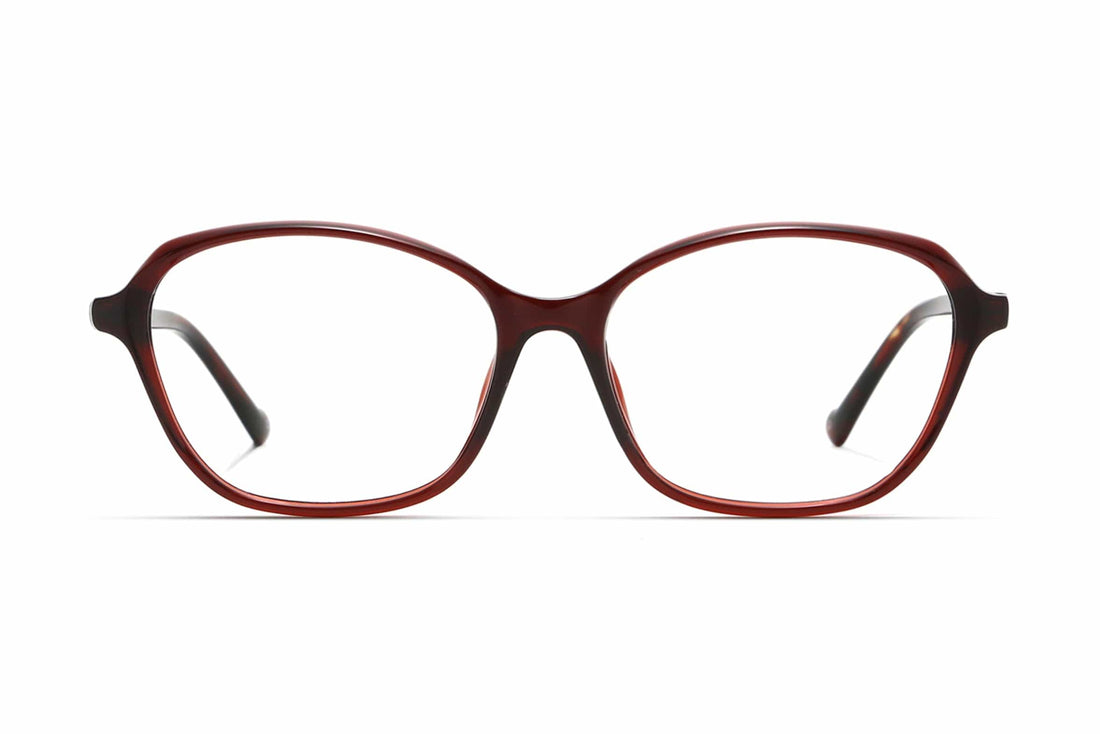
Acetate has been the workhorse material for prescription frames for decades because it hits a rare balance. It’s substantial enough to hold a full-rim structure around any lens thickness, warms to skin temperature after a few minutes of wear, and can be reshaped by an optician if the fit drifts a year in. Bio-acetate is the sustainable evolution — same material behaviour, plant-based inputs (cotton seed and wood pulp), meaningfully lower environmental footprint. For anyone who folds, cleans, and unfolds their glasses dozens of times a week, acetate frames hold up better than injection-molded plastic and doesn’t fatigue at the hinges the way cheaper alternatives do.
Wood and wood-blend
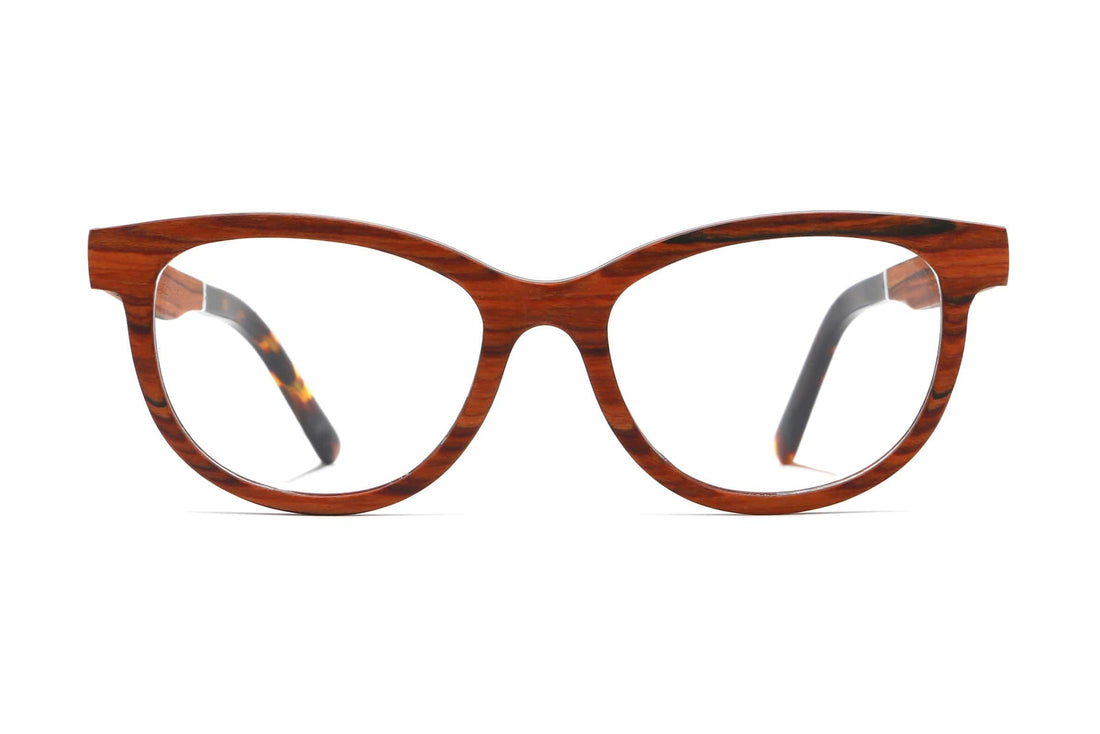
Wood frames are a signature choice for anyone who wants a frame that isn’t identical to the pair next to them. Grain patterns vary from cut to cut, so every set of temples has a slightly different finish. The historical trade-off was rigidity — pure wooden frames couldn’t be reshaped the way acetate could — but modern wood-blend frames solve this by pairing wooden temples with an acetate or metal front, keeping the visual character while preserving adjustability. Kraywoods works primarily in FSC-certified wood and bio-acetate, designed in Canada with lens-cutting done in our own optical lab.
Metal
Metal frames trade the warmth of acetate for a lower-profile silhouette and the lightest possible weight on the nose. Titanium is the standout — hypoallergenic, virtually corrosion-proof, and light enough that you’ll stop noticing the frame within minutes. Stainless steel and aluminum alloys sit below titanium in longevity but are meaningfully cheaper. Metal works best for readers who want their eyeglasses to fade visually into their face rather than sit as a design statement, and for anyone whose skin occasionally reacts to acetate over long wear.
Frame material and lens strength (a note worth knowing)
Frame material also affects how well a frame handles your specific prescription. Higher prescriptions (above roughly ±4.00 sphere) benefit from full-rim acetate or metal frames because they hide the lens edge thickness. Rimless and semi-rimless frames, popular for their invisibility, expose the lens edge and only look right on lower prescriptions. This is one of the few places where prescription strength meaningfully overrides personal style — pick a frame that works with your lenses, not against them.
Injection-molded plastic (why to skip it)
Budget plastic frames feel light in the hand, but they don’t handle the daily folding, wiping, and small pressure that eyeglasses actually go through. Hinges loosen within months, the frame front warps under sun or car heat, and the surface finish scratches off with regular cleaning. Fine as a backup pair or a stopgap between eye exams — not what you want to spend eight hours a day wearing.
How to size eyeglasses properly
Ill-fitting eyeglasses do more than sit awkwardly — they can quietly undercut your prescription. A frame that keeps slipping forward, digs in above the ears, or sits off-centre pushes the optical zone of each lens away from your pupils, making the prescription work harder than it should. Every frame carries three sizing numbers etched inside a temple arm (typically formatted like “52-18-140”), and they describe:
-
Lens width — how wide a single lens measures across; adult frames typically land between 48 and 56mm
-
Bridge width — the gap that spans your nose between the two lenses, typically 16 to 20mm on adult frames
-
Temple length — how long each arm runs from the hinge back to the ear tip, typically 135 to 150mm
Fastest way to shop for the right size: pull out a pair of your current glasses that fit well, read the numbers etched inside one temple arm, and use those as your starting point.
Why PD matters (and how to find yours)
Pupillary distance (PD) is the millimeter distance between the centres of your two pupils. It’s a critical measurement for prescription eyeglasses because it tells the lab exactly where to place the optical centre of each lens. Even a small PD error can cause eye strain, blurring at the edges, or headaches — problems that get misattributed to the prescription itself when the actual issue is placement.
Most adults have a PD between 54 and 74mm. You can measure your own PD at home with a ruler and a mirror, or ask your optometrist to include the number on your prescription. Any reputable online eyewear brand will ask for your PD before making your lenses; if they don’t, that’s a red flag.
The fit test
Numbers only get you so far. The physical fit test is what confirms the size actually works. Put the pair on and check three things: the bridge should rest on your nose without leaving pressure marks after a minute, the temples should follow the sides of your head without floating or squeezing, and when you look down or nod, the frame shouldn’t shift forward. If any of those three fail, the size isn’t right for you — regardless of what the temple arm says.
Choosing eyeglasses by use case
Face shape narrows down the frame silhouettes that flatter you; use case narrows down the lens, coating, and fit choices that actually shape how the pair performs. In practice, buyers who get the second right end up with a pair they reach for daily. Buyers who chase style alone end up with a pair they replace within a year.
Eyeglasses for office and screen-heavy work
Screen fatigue is the most common reason people update their eyeglasses in 2026. If you spend more than four hours a day at a screen, anti-reflective and blue light coatings are the two to prioritize together — the combination does more for screen comfort than either alone. Anti-fatigue lenses (a specialized design with a small reading-strength boost in the lower portion) are worth looking at for screen-heavy readers over 35 who notice their eyes tiring by evening.
Eyeglasses for everyday all-day wear
For general daily use — errands, work, evenings out — the priorities shift toward comfort, weight, and versatility. Lightweight materials (bio-acetate, titanium, wood-blend frames), reinforced hinges, and colours that read as understated tend to travel well across settings. Everyday eyeglasses justify spending a bit more on build quality than you might expect — you’re wearing them across hundreds of days a year, and the pairs that survive that kind of use rely on solid hinges, a finish that doesn’t chip, and materials that don’t warp when they’re left in a hot car. Cheap frames end up costing more over three years because they cycle through the replacement pile faster. If you’re browsing by style, the men’s eyeglasses and women’s eyeglasses collections group frames by common fit and style patterns for each.
Eyeglasses for active lifestyles
Prescription eyeglasses worn during running, cycling, or outdoor time face different stresses than desk-bound pairs. Sweat, jolts, and the occasional stray branch all put pressure on the frame in ways that expose weak hinges within weeks. Spring-loaded hinges are basically a requirement here — they flex when the temples get pushed outward and snap back without loosening. Lens material matters too: polycarbonate and Trivex are the two go-to picks because they handle impact far better than standard resin. Bio-acetate frames with spring hinges quietly outperform sport-branded plastic for a lot of activities; the “sporty” look isn’t the same as sporty function.
Eyeglasses for reading and up-close tasks
If reading is the only vision correction you need, dedicated reading glasses are cheaper and lighter than progressives or bifocals — you’ll only wear them when reading, and the single-focus design keeps the lens simpler. If you also need distance correction, progressives are more practical than switching between two pairs. Frame size for reading glasses can be slightly smaller since they only need to cover your near-vision field, not your full field of view.
Eyeglasses for sensitive eyes and higher prescriptions
Light sensitivity, migraines, and higher prescriptions all shift the buying priorities. Light-sensitive readers benefit from photochromic lenses (darken outdoors, clear indoors) or an FL-41 tint that filters wavelengths some migraine sufferers find triggering. Higher prescriptions (above ±4.00 sphere) benefit from smaller lens widths and higher-index lens materials, which keep lenses thin enough to fit comfortably in modern frames. Full-rim frames tend to work better than rimless or semi-rimless for higher scripts, since they hide the lens edge thickness.
Face shape considerations
The face shape logic for eyeglasses is straightforward: pick a frame that contrasts with your dominant facial feature. A round face reads more defined in a sharper, more geometric frame; an angular jaw softens under rounder or curved silhouettes; a heart-shaped face balances better with a frame that carries more visual weight along the bottom edge.
The full shape-by-shape breakdown, with detailed frame recommendations for each face type, lives in the Face Shape Guide for Glasses.
How to verify prescription accuracy and lens quality
Prescription eyeglasses have a genuine quality-control challenge that sunglasses don’t: the lenses are custom-cut to your eyes, and small errors in prescription execution, PD placement, or coating application quietly make the pair less effective without being obvious to a first-time wearer. Three checks catch most issues:
Check 1: The prescription match
When your new eyeglasses arrive, look at the paperwork or online order confirmation and verify that the prescription values match what your optometrist gave you: sphere, cylinder, axis, and PD for each eye. Small differences in how the numbers are formatted are normal; substantive differences aren’t. This is the first thing to catch and the easiest to fix if the mismatch happened at order time.
Check 2: The optical centre test
Wear the new eyeglasses in front of a mirror and check that the optical centre of each lens sits directly in front of your pupil, not off to the side. Off-centre lenses cause eye strain because your eyes have to work harder to compensate for the misalignment. This test takes 10 seconds and catches PD errors that would otherwise cause weeks of unexplained fatigue and headaches.
Check 3: The AR coating verification
Genuine anti-reflective coating shows a faint green, blue, or purple tint when you tilt the lens under light. If your lenses show plain white reflections at every angle, the AR coating either wasn’t applied or wasn’t applied properly. Reputable optical brands include AR as standard; if you paid for it and don’t see the coloured reflection, ask for a re-cut.
For rigorous verification, most optical shops will check a lens against your prescription card on request — a useful last step if you’ve paid for a mid-premium pair and want to close the loop before you commit to wearing it daily. And if the pair you’re already wearing has been feeling wrong lately, the issue often isn’t the frames — it’s the prescription itself. Our guide to knowing when your glasses prescription is outdated walks through the signs.
Warranty, returns, and how long good eyeglasses should last
Warranty terms are the most honest number on any brand’s product page. A short return window with no follow-on coverage tells you the seller expects the product to fail; a 12-month structural warranty tells you the opposite. Kraywoods runs 12-month coverage on every pair as a matter of default — the warranty length is a useful proxy for how long the frame is genuinely built to last.
Here’s what a solid coverage policy actually looks like:
-
Structural coverage — hinges, temples, and bridge should carry at least 12 months against manufacturing defects
-
Prescription eyewear return policy — usually 30 days on unworn or prescription-adjusted frames; custom-cut lenses justify the shorter window compared to sunglasses
-
Coating durability — a good AR or blue light coating shouldn’t peel or scratch through under normal cleaning inside the warranty period
-
Replacement parts availability — nose pads, hinge screws, and case replacements should be easy to source; brands that stock them tend to build for longevity rather than turnover
Realistically, a mid-premium pair in the $150–300 range should carry you through 3 to 5 years of daily wear before the prescription itself changes. Many wearers keep the frame beyond that and just have the lenses re-cut after their next eye exam — the frame is often the durable half of the pair. Sub-$50 frames rarely make it past the 12–18 month mark before hinges fail or the finish gives out.
Key takeaways
-
Eyeglasses buying decisions come down to prescription accuracy, lens quality with coatings included, frame integrity, and long-day fit. Everything else is downstream of those four.
-
Anti-reflective and anti-scratch coatings belong on every prescription pair as standard. Blue light filtering earns its keep for screen-heavy readers; photochromic lenses do the same for people who don’t want to switch between clear and prescription sunglasses.
-
PD (pupillary distance) matters as much as the prescription itself. A perfectly ground lens placed off-centre causes eye strain that’s easy to blame on the wrong thing.
-
Fit is set by the three sizing numbers etched inside a temple arm — lens width, bridge, temple length. The fastest calibration is to read those numbers off a pair that already fits you comfortably.
-
Match your pair to how you actually spend your time. Office, everyday, active, reading, and sensitive-eye priorities each pull the buying decision in a different direction; aesthetics come after.
-
Warranty length is the most honest signal about how long a brand expects its frames to last. Look for 12 months minimum on structure, plus coating coverage that runs at least as long.
Final thoughts
Buying eyeglasses well comes down to knowing which factors carry weight and which don’t. Accurate prescription, coatings that come standard, a frame built to hold its shape, and a fit that survives daily wear — that’s the substance. Colour, silhouette, and style are legitimate but personal; nobody outside your own preferences can rank them for you. The framework above works the same way whether it’s your first pair of eyeglasses or your fifth.
At Kraywoods, every pair is designed in Canada, with prescription lenses cut at our in-house optical lab, from wooden to bio-acetate frames sourced from FSC-certified suppliers, anti-reflective and anti-scratch coatings included at the base price, and a 12-month warranty on the frame. Browse all eyeglasses, and If you’re picking a sunglasses pair alongside your eyeglasses, the parallel decisions are in the How to Choose Sunglasses guide.
Frequently Asked Questions
How do I know my pupillary distance (PD)?
Pupillary distance is the millimeter distance between your two pupils, and it’s needed for accurate prescription eyeglasses. Most adults measure between 54 and 74mm. You can measure yours at home using a ruler and a mirror, or ask your optometrist to include the number on your prescription, which many now do by default.
Do I actually need blue light glasses?
Blue light filtering coatings are worth adding for readers who spend more than four hours daily on screens and notice end-of-day eye fatigue. Research on blue light’s long-term effects is still developing, but many wearers report meaningful comfort improvement. The coating is inexpensive when included from the start and doesn’t affect how you perceive colour.
What’s the difference between single vision, progressive, and bifocal lenses?
Single vision lenses have one prescription across the whole lens, for either distance or reading. Progressives blend distance, intermediate, and reading zones smoothly without visible lines, making them the most versatile choice for people over 40. Bifocals split distance and reading into two visible zones — cheaper and simpler, but with a visible line most modern wearers dislike.
How do I know if my eyeglasses frames fit correctly?
A frame that fits sits on the bridge of the nose without leaving pressure marks after a minute, keeps the temples in light contact with the sides of the head without squeezing, and stays in place when you tilt your head down. The three sizing numbers etched inside the temple arm — lens width, bridge, temple length — should be close to those of a pair you already wear comfortably.
Are expensive eyeglasses actually worth it?
In the $150–300 range, the extra spend usually goes toward measurable things: tighter prescription accuracy, coatings baked into the base price, sturdier frame materials, and warranty coverage that actually pays out. Past $300, most of what you’re paying for is brand equity rather than better build. Under $50, prescription accuracy and coating quality both fall off in ways that catch up with you within a year.
How long should a pair of eyeglasses last?
A well-built pair typically holds up for the length of your prescription — usually 2 to 3 years between eye exams — and often longer, since many wearers keep the same frame and re-lens after their next check-up. The two things that cut lifespan short are hinge fatigue on cheap frames and coating wear from harsh cleaning. Both are avoidable with better initial choice and gentler care.
 Rayhan El-Asmar
How to Choose Eyeglasses: The 2026 Buying Guide
Shop by category